Transforming structure to reveal functionality
WHY STRUCTURE MATTERS
Its morphology, particle size, porosity and accessible surface area also influence its behaviour in a matrix or an industrial process.
By breaking down particles and increasing their contact surface, micronisation makes it possible to work on this structure.
Micronisation can thus modify a material's behaviour: dispersion, hydration, texture, stability, microbial accessibility, exposure of wall-associated compounds or fermentability, depending on the matrix and the application.
This is the case, for example, with the accessibility of what cell walls contain: in many plant matrices, a significant proportion of phenolic compounds is bound to the walls rather than present in free form — an arrangement that micronisation helps to make accessible.
Two practical applications, in two very different fields.

On wheat fractions, this multiplied surface makes the insoluble fractions directly accessible to microbial colonisation.

This accessibility favours bacterial colonisation associated with the soluble fractions and a progressive fermentation, oriented towards short-chain volatile fatty acids.

Some of the phenolic compounds, including ferulic acid, are bound to the cell walls of wheat fractions. Micronisation breaks open the cells and directly exposes some of these compounds; bound ferulic acid, for its part, is gradually released through the fermentative activity of the microbiota.
→ What the research says: micronisation of wheat fractions

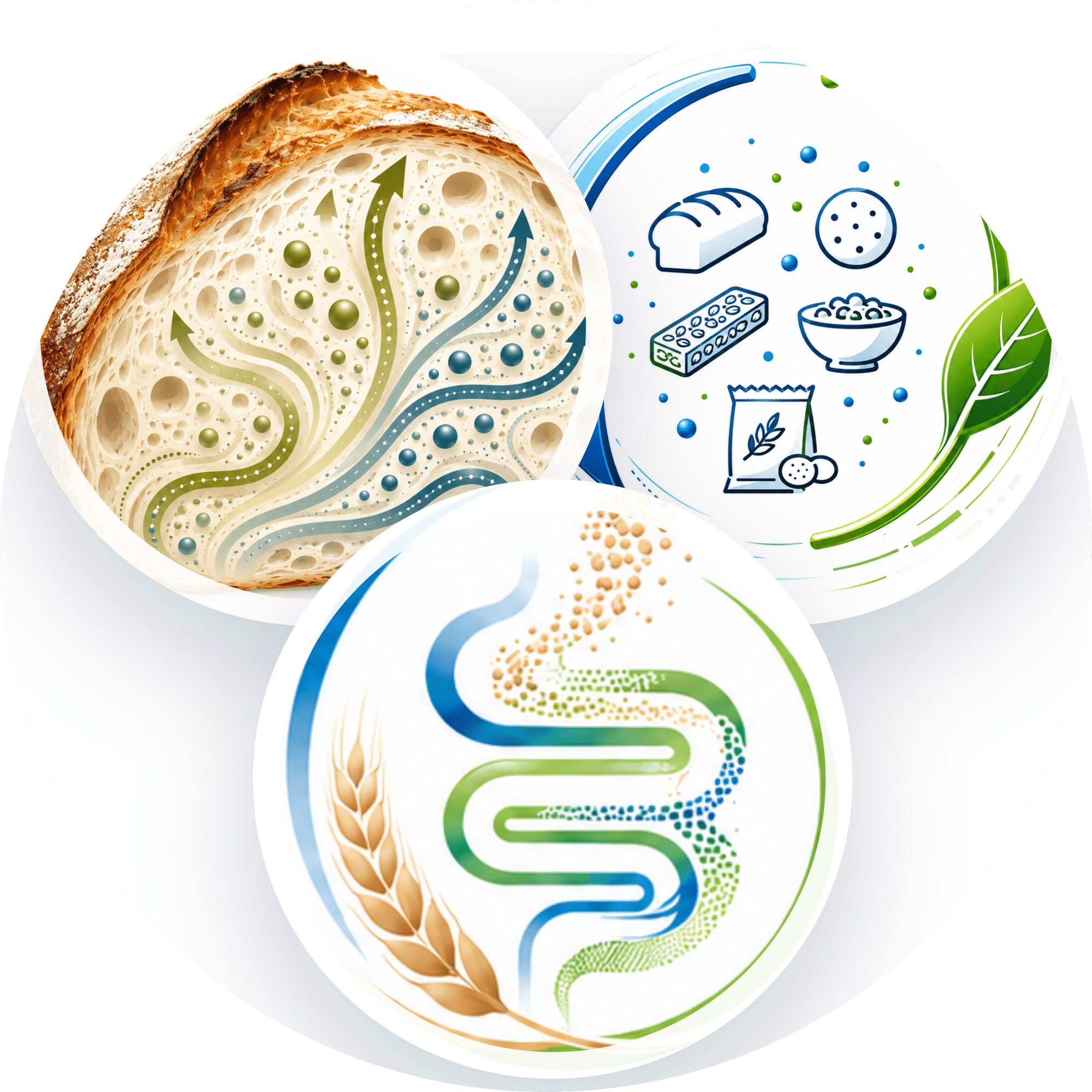
After extraction, plant fibres of interest are activated through micronisation.
On plant fibres intended for oenology, this same multiplied surface exposes more retention sites: through physical adsorption and without chemical bonding, they then adsorb pesticide molecules and mycotoxins such as ochratoxin A — a phenomenon that remains stable over time, as documented by the REALDYME patent.
Breaking down the particles of a plant fibre through micronisation can reveal unsuspected functional properties, beyond REALDYME's own applications. Several examples, scientifically validated and/or industrially exploited, illustrate this.
Gelling, thickening, stabilising
Stabilising emulsions
Providing a texturising filler
Reinforcing bio-based materials
Four fibres, three sectors, one common thread: micronisation alone — without chemicals, without solvents — helps transform a plant co-product into a functional ingredient.
REALDYME micronisation is a dry mechanical process, with no solvents, no chemical treatment and no cooking, which breaks down the material, increases its contact surface and preserves the plant material.
Working on the physical structure of plant materials opens up new prospects for resources that are sometimes still under-valorised: cereal brans, husks, hulls, fibrous fractions and other agricultural and food co-products.
Micronisation can help reveal their potential for use, in food as well as in process or technical applications.
From initial trials to recurring industrial volumes, REALDYME can assess the feasibility of your material.
 Buy Doses-O-Son